
.png)
Contact
Find us
- RCK Partners,
70 Gracechurch Street,
London,
EC3V 0HR.
© 2024 RCK Partners - Company House No: 12396021

%20(4).png)
Capital allowances are one of the most valuable tax reliefs available to UK businesses, but they are not claimed automatically. Understanding the claim process is the first step to ensuring your business tax position is optimised.
This guide explains who can claim capital allowances, the step-by-step HMRC process, how to calculate the relief, and what claiming capital allowances involves for specific property types and sectors.
Capital allowances can be claimed by any UK taxpaying entity that has incurred qualifying capital expenditure in connection with a trade or business. This includes:
To be eligible, you must own the asset, use it for business purposes, and have incurred the cost as capital expenditure rather than a day-to-day revenue expense. Learn more about what is eligible for capital allowances.
Making a capital allowance claim in the UK involves five stages, from identifying qualifying expenditure through to submission in your tax return.
The calculation method for expensing capital expenditures depends on which allowance applies:
Example: a company spends £500,000 on office fit-out (main rate plant and machinery) and £200,000 on HVAC and electrical systems (special rate). Under Full Expensing: £500,000 deducted at 100%; 50% of the special rate spend (£100,000) deducted immediately via the 50% first-year allowance; £100,000 enters the special rate pool at 6% WDA. Total first-year relief: £606,000.
The most commonly claimed category of capital allowances is plant and machinery, which covers a wide range of business assets beyond commercial property. Any UK business can claim on qualifying plant and machinery provided the asset is owned and used for business purposes. Common examples include:
For most businesses, the Annual Investment Allowance covers the full cost in the year of purchase. See the calculation section above for the full rate breakdown. The five-step process above applies equally to plant and machinery claims — the key difference from property claims is that a specialist survey is not usually required, as the assets are straightforward to identify and value.
Commercial vehicles including vans and lorries qualify for the Annual Investment Allowance in the same way as other plant and machinery. Cars are treated differently. They are excluded from AIA and Full Expensing and use Writing Down Allowances instead, with the rate depending on CO2 emissions. Zero-emission cars qualify for a 100% first-year allowance until March/April 2027 - learn more about Low Emission Vehicle Allowances.
The process for claiming capital allowances follows the same five steps outlined above, but the qualifying assets and survey complexity vary significantly by property type and sector. Below is a guide to the most commonly claimed areas.
Claiming capital allowances on commercial buildings centres on identifying embedded plant and machinery: heating, ventilation, air conditioning, electrical and lighting systems, cold water plumbing, lifts, fitted kitchens, and thermal insulation. These assets are physically part of the building and often not recorded in standard accounting records.
A specialist capital allowances survey is typically required to identify and value these assets accurately. For property acquisitions, the survey sits alongside a review of legal and cost documentation. When buying a second-hand commercial building, a Section 198 election must be agreed between buyer and seller within two years of completion. Missing this deadline can permanently remove the buyer's right to claim on acquired fixtures.
Care homes contain significant qualifying plant and machinery: specialist clinical equipment, assistive technology, complex HVAC systems, and dedicated welfare facilities. The combination of clinical, residential, and commercial use means a detailed survey is important to correctly distinguish qualifying assets from non-qualifying residential elements.
A specialist prepares a capital allowances report categorising all qualifying expenditure by pool. This is submitted to HMRC via the operator's tax return, reducing taxable profits accordingly.
Hospitals, clinics, GP surgeries, dental practices, and veterinary surgeries all contain qualifying assets: medical equipment, specialist electrical systems, purpose-built clinical environments, and staff welfare facilities. The key is correctly distinguishing plant and machinery from the non-qualifying building fabric, which requires specialist tax and surveying expertise.
Healthcare operators should consider capital allowances at the design and construction stage. Identifying qualifying assets early means costs are correctly recorded from the outset and the maximum available relief is secured.
Hotels routinely generate some of the most substantial capital allowances claims across any property type. Qualifying expenditure spans multiple allowance pools:
The Section 198 election process is particularly important for hotel acquisitions, as the value of embedded fixtures is typically high. A specialist survey at the point of purchase or refurbishment will identify and value all qualifying assets before the claim is submitted.
Restaurants, bars, pubs, and event venues contain significant qualifying plant and machinery: commercial kitchens, specialist electrical systems, HVAC, bar fittings, and audio-visual equipment can all attract relief. The value of embedded fixtures in second-hand hospitality properties is frequently overlooked without specialist input.
Capital allowances on hospitality property should be considered at acquisition, during refurbishment, or as a retrospective review of historic expenditure where relief has not previously been claimed.
Industrial properties (warehouses, factories, distribution centres, and manufacturing facilities) typically carry high-value plant and machinery including specialist machinery, racking, conveyor systems, electrical infrastructure, and ventilation. Claims in this sector often represent some of the highest values relative to total property cost.
Both owner-occupiers and property investors can claim capital allowances on industrial property, and retrospective claims on assets still owned and used in the trade can be made where historic expenditure has not been fully claimed.
Property developers can claim capital allowances on plant and machinery used in the development process itself — site equipment, cranes, and temporary structures used in the trade. Expenditure on the buildings being developed is generally treated as trading stock where properties are built for sale, and does not qualify.
Where a developer retains completed units for commercial letting rather than selling them, capital allowances on embedded fixtures in those retained properties may be available. The line between trading and investment activity is not always straightforward, so specialist advice is worth taking before making a claim.
For any of the sectors above, the starting point is the same: an initial review of your capital expenditure to establish what qualifies and what a claim could be worth.
Let our team support you with your claim.
Anastasiya Kokonova
Anastasiya is a Chartered Quantity Surveyor with 16 years of experience in the Capital Allowances sector. Prior to specialising in Capital Allowances, Anastasiya has worked as a Quantity Surveyor for 3 years for a large QS firm where she has gained experience in both new build and fit out projects.
Anastasiya has provided Capital Allowances advice and undertaken claims on hundreds of properties and commercial transactions and has advised a wide variety of property investors across different sectors including high net worth individuals, hoteliers, retailers, media and investment companies and owner occupiers. Anastasiya holds a Masters Degree in Corporate Real Estate Finance and Strategy.
A successful project which was undertaken by our specialists comprises a client who constructed two poultry sheds at a cost of approximately £3 million.
Our expert consultants undertook a site survey which allowed them to gain a real understanding of all the costs that had been incurred. This, therefore, allowed them to create a detailed analysis of expenditure, to identify any possible tax benefits that they could claim.
Our team of Capital Allowance specialists were able to identify and secure a tax saving of over £500k for our client. This was achieved by carefully reviewing the client’s expenditure and identifying any qualifying items that could be claimed for Capital Allowances.
As a result of our specialised work, the client was able to significantly reduce their tax liability for the next four years; they were pleased to have received the advice and support of our experts which allowed them to make the most of the available tax reliefs and benefits that were available to them.
Capital allowance claims are made through your annual tax return — the CT600 for companies or Self Assessment for individuals. The filing deadline aligns with your standard tax return deadline. For commercial property transactions, Section 198 elections must be submitted within two years of the purchase completion date. Missing this permanently removes the right to claim on acquired fixtures.
Yes. There is no general time limit on claiming capital allowances for assets still owned and used within the trade. A specialist review can identify unclaimed relief on historic expenditure, for example, on embedded fixtures in a commercial property acquired years ago, and prepare the claim for inclusion in the current year's return.
You can technically make a claim without specialist support, but the rules for commercial property and embedded fixtures are complex and change regularly. A specialist with both tax and quantity surveying expertise will ensure all qualifying expenditure is identified, correctly categorised, and fully disclosed, minimising HMRC enquiry risk and maximising the value of the claim. Get in contact with RCK to find out how we can help.
You will need: purchase invoices and contracts for qualifying assets; bank statements or payment records; construction schedules and cost breakdowns for property claims; a fixed asset register where available; and for commercial property, a specialist capital allowances survey report. HMRC may request this evidence on enquiry.
When you dispose of an asset on which capital allowances have been claimed, a disposal value enters the pool. If the disposal value is below the remaining pool balance, a balancing allowance arises, giving additional relief. If it exceeds the pool balance, a balancing charge arises, which is treated as taxable income. For Full Expensing and the 50% first-year allowance, the entire sale proceeds are brought in as a balancing charge in the year of disposal.
Every business is different, and eligibility depends on the nature of the expenditure, how assets are owned, and how they are used in the trade. Get in touch with RCK Partners to find out whether a claim is viable and what it could be worth, or learn more about what is eligible for capital allowances.
Find out who can claim capital allowances in the UK, and which assets and property types qualify.
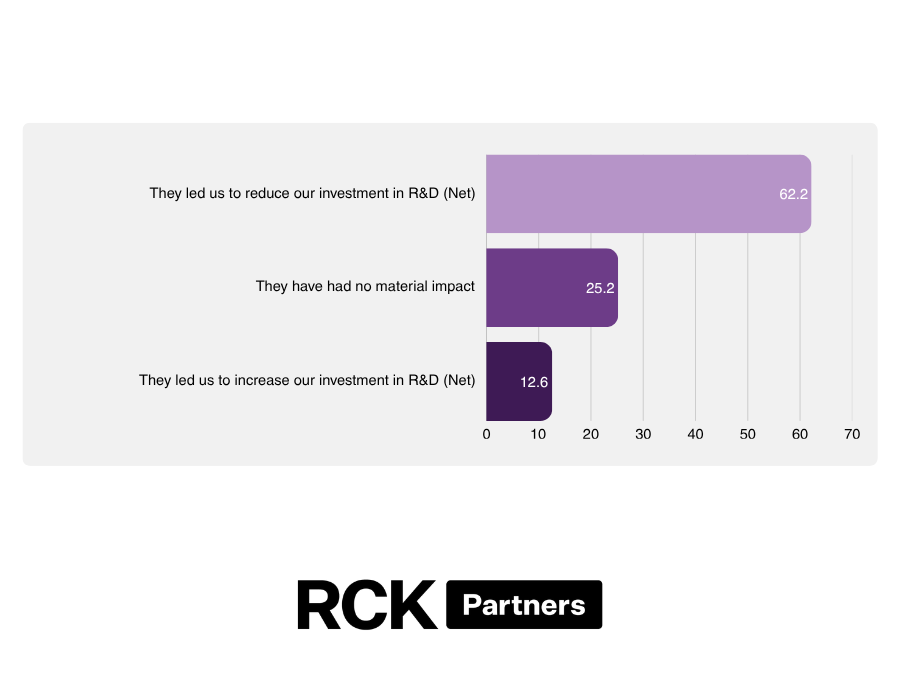
A Times-featured study, commissioned by RCK Partners and conducted by Censuswide, suggests that recent reforms to the UK's R&D tax relief scheme may have gone too far. The research found that measures introduced by HMRC to tackle abuse of the scheme are having unintended consequences for genuine innovators, with many businesses reporting that they have cancelled research initiatives, paused investment plans and reduced skilled headcount as a result of increased uncertainty surrounding the regime.
Capital allowances are the main form of UK tax relief that allows businesses and property owners to deduct the cost of qualifying capital assets from their taxable profits. Governed by the Capital Allowances Act 2001, they take the place of commercial depreciation and provide a structured mechanism for obtaining relief on capital expenditure, either upfront or over time.