
%20(4).png)
Contact
Find us
- RCK Partners,
70 Gracechurch Street,
London,
EC3V 0HR.
© 2024 RCK Partners - Company House No: 12396021


Innovation in the defence sector differs from that in many other industries. Projects are often developed within highly secure environments, where sensitive technical information cannot be shared and confidentiality is critical.
UK defence companies claiming R&D tax credits face unique compliance challenges and this complexity is exactly why many defence businesses either avoid claiming R&D tax credits in entirety, or submit claims that are later enquired by HMRC due to a lack of supporting evidence.
In our experience at RCK Partners, the problem is rarely that the work itself is ineligible. More often, claims fail because businesses struggle to translate highly technical and sensitive defence activity into a format that satisfies HMRC’s evidence expectations and thresholds without compromising sensitive company and project information.
The reality is that defence companies are often undertaking some of the UK’s most advanced qualifying R&D projects and should not be deterred from claiming. This is why specialist defence-sector expertise matters when claiming R&D tax credits.
This guide walks through the most common compliance risks in defence R&D Tax Relief claims and how businesses can structure claims for sensitive projects to satisfy HMRCs requirements and to withstand their scrutiny.
For companies operating within the defence and dual-technology sectors, the challenge is often not whether qualifying R&D exists, it is whether the claim has been structured in a way that satisfies HMRC’s criteria.
Because defence projects are typically complex, sensitive, and highly technical, claims can quickly run into issues if evidence is not substantiated correctly. This is why we advise working with a R&D tax credit agent who has a bespoke defence team, such as RCK Partners, who have security cleared personnel and can translate this sensitive information into a format which satisfies HMRC's requirements.
Below are the areas where we most commonly see defence-sector claims encounter problems during HMRC reviews.
One of the biggest compliance risks is misunderstanding what actually qualifies as R&D for tax purposes.
Many defence businesses assume that because a project is technically advanced, bespoke, or linked to national security, it automatically qualifies. However, HMRC’s definition of R&D focuses on whether the company attempted to resolve scientific or technological uncertainty.
This is particularly important in defence environments where projects often involve a mixture of:
HMRC expects businesses to demonstrate:
To summarise, a company must be trying to achieve something that the wider field didn't know how to effectively do at the outset and which couldn't be readily worked out by a competent professional using information which is publicly available.
Defence-sector claims can be scrutinised because projects operate within secure or classified environments where documentation can be fragmented or insufficient.
As a result, key information is often omitted from the R&D report or Additional Information Form (AIF) by either the company or its provider. To address this, RCK Partners offers guidance to ensure that the developments undertaken are communicated in line with HMRC guidance and expectations, helping to mitigate risk within the submission.
The main evidence issue that we see is that detailed records are kept but due to the sensitive nature of the data, some clients are hesitant in disclosing this information.
We as a specialist defence R&D tax credit provider, are well placed to handle this evidence, involving appropriately security cleared personnel where necessary, to translate this into a format which doesn't compromise this information, yet satisfies HMRCs requirements to successfully award the credit.
In defence environments, claims need to be prepared carefully to balance HMRC requirements with security obligations. This is where specialist advisors with defence-sector experience can make a significant difference.
Subcontracting is one of the most misunderstood areas of UK R&D Tax Relief, particularly within defence supply chains where multiple contractors and specialist providers may be involved. Whether subcontractor costs qualify depends on several factors, including:
Engaging specialist advice ensures these risks are mitigated from the outset for the claiming company.
Project narratives are one of the most important parts of any R&D Tax Relief claim, yet they are also one of the areas where defence companies most commonly encounter difficulties. Since projects are sensitive or classified, businesses often remove too much technical detail from submissions or focus on the unrelated details to the R&D Legislation. The result is narratives that are too vague for HMRC to properly assess the R&D taking place.
For defence businesses, preparing project narratives often requires a careful balance between technical detail, compliance requirements, and security considerations, which is why specialist defence-sector expertise is so important in claim preparation. Importantly, this can still be achieved without disclosing classified or operationally sensitive information when communicated correctly.
RCK Partners operate a layered, 360-degree defence R&D tax credit advisory model including:
Combined, this allows RCK Partners to help defence businesses submit robust, compliant claims while carefully managing confidentiality and security considerations. Read more about RCK’s defence initiative on our dedicated webpage.
At RCK Partners, we believe that a strong process is protection. Please see an outline of our framework for delivering an R&D within the defence sector below:
At RCK Partners, we do not retain classified data on our systems, but instead we work with clients at their locations and on their systems, to access the information that we need in order to prepare a claim with appropriate detail at the right security classification. This ensures that our client’s raw data remains secure, but that the R&D claim meets HMRC requirements for detail.
Defence companies are undertaking some of the most complex and advanced R&D in the UK, yet many claims still fail under HMRC scrutiny.
In most cases, the issue is not eligibility, it is how the claim has been structured, evidenced, and communicated. Balancing HMRC’s requirement for detailed technical evidence with the need to protect sensitive information requires a highly specialised approach.
With the right structure, supporting evidence, and technical narrative, defence-sector claims can be both compliant and robust, without compromising security.
If your business is carrying out innovative work but is uncertain whether your claim would withstand HMRC scrutiny, speaking to an RCK Partners adviser with defence-sector expertise can make the difference between a rejected submission and a successful, defendable claim.
Get in touch to speak with a member of our defence team.
Gajan is a Principal Consultant at RCK Partners, specialising in complex, software-led R&D across VC-backed technology companies, deep-tech start-ups, and dual-use organisations. He leads end-to-end R&D delivery for claims within the technology sector, translating advanced engineering projects into compliant claims that deliver commercial value. Since joining RCK, Gajan has played a key role in building the firm’s software-focused R&D capabilities, enabling the secure onboarding and delivery of work for large multinational and emerging multinational technology companies. More recently, he has helped establish RCK’s dedicated defence and dual-use R&D offering, supporting organisations operating in highly regulated and sensitive industries. Gajan works closely with CTOs, engineers, and founders to coordinate technical inputs, assess system design and technical risk and translate complex engineering work into robust, defensible R&D submissions. To date, he has delivered over 300 R&D claims within the SME, RDEC, ERIS and Merged Schemes.
Albert holds a BEng in Aerospace Engineering (Design) and a MSc in Advanced Motorsport Engineering from Cranfield University. He has industrial experience within the aerospace and automotive sector. Since joining RCK in September 2022 as an Associate R&D consultant, and now an Assistant R&D Manager, he has compiled claims for a range of sectors including defence, agriculture, engineering, oil and gas, and construction. He has an interest in the Engineering sector (defence, aerospace, automotive, marine, motorsport and precision engineering) within the scope of technology and manufacturing developments.
Find out who can claim capital allowances in the UK, and which assets and property types qualify.
A step-by-step guide to making a capital allowance claim in the UK.
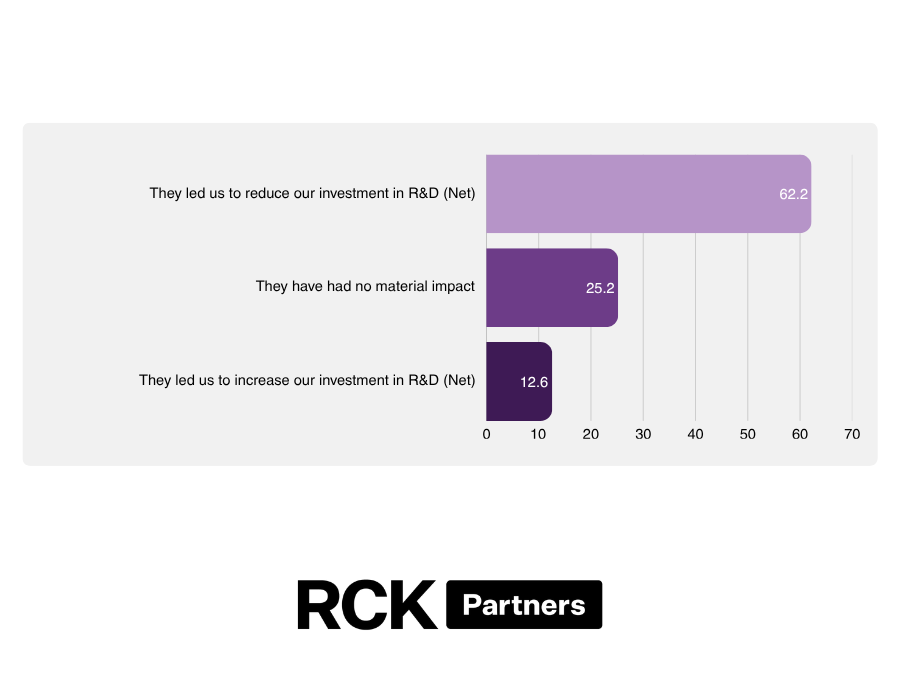
A Times-featured study, commissioned by RCK Partners and conducted by Censuswide, suggests that recent reforms to the UK's R&D tax relief scheme may have gone too far. The research found that measures introduced by HMRC to tackle abuse of the scheme are having unintended consequences for genuine innovators, with many businesses reporting that they have cancelled research initiatives, paused investment plans and reduced skilled headcount as a result of increased uncertainty surrounding the regime.